|
|
|
 |
| |
| |
 |
Size |
| AX, BX, NX, AQ, BQ, NQ, NQ3, HQ, HQ3, DCDMA standard size. |
| |
|
Usage |
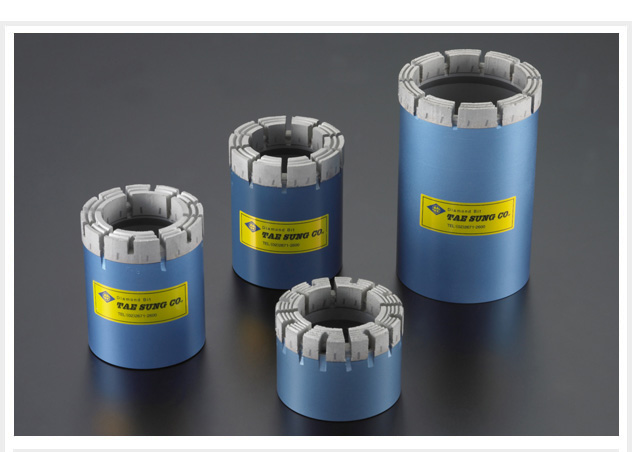
A bit is installed at the front of core barrels to dig the ground.
It serves the most important purpose in all drilling machines.
There are many types of drills that are used according to the purpose of boring or the condition of the ground.
It is economical to fully understand the characteristics of each drill before use, as each drill has its own quality, shape, and performance.
A diamond core bit is used to hard base rock boring, while a metal is used for sedimentary rocks.
An impregnated core bit is commonly used when a core is needed in boring, while a non-core bit is used when you do not need a core in the work.
However, using core bits are more effective and reduce costs a lot.
Impregnated diamond core bit is made of diamonds, the hardest of materials. It is made by mixing various metal powders (bronze, copper, cobalt) in the matrix as same as abrasive stones and synthetic diamond, and sintering them at a high temperature. Bits are consisted of a shank and a matrix.
A shank has screws so that it can be attached to core barrels and rods.
The matrix is made by mixing metal powder with diamonds and sintering them.
A hard matrix is used in sedimentary rocks and a soft matrix is used for hard rocks.
|
| |
|
The characteristics of impregnated diamond core bits of Taesung |
1. They have a world-class quality.
2. The bits of Taesung are accustomed to the strong and hard rocks in Korea, having a great capabilityin tunneling.
3. The firm has taken a firm stance in Korea.
4. Any type or size can be produced.
5. The speed of tunneling by impregnated diamond core bits is unmatched by any other companies' products.
6. It has the best quality synthetic diamond powder, best metal powder, and shank. |
| |
|
The hardness of the matrix is an essential factor in deciding a bit. |
1) A strong matrix and a large diamond is used for soft rock
2) A middle matrix and a medium diamond is used for medium hard rock
3) A soft matrix and a small diamond is used for hard rock |
| |
| Sign of Matrix |
T1, T2 |
T3, T4 |
T5 ~ T8 |
T9 ~ T11 |
| Section / kind of rocks |
Soft rock |
Medium hard rock |
Hard rock |
Very hard &
Ultra hard rock |
| Diamond mesh |
Large small |
| Matrix Hardness |
HARD SOFT |
|
| |
 |
Impregnated Core Bit Matrix Selection Chart |
| |
| Rock Hardness |
Rock Characteristics |
Type of Rock
(Example) |
Tae Sung
(T-Series) |
| DCDMA |
MOHS |
| 7 |
8-9 |
Extremely Hard, unbroken fine
grained formation, non-abrasve |
Quartz
Chert
Jasper |
T-9,10,11 |
| 7 |
8 |
Very Hard, unbroken fine
grained formation, non-abrasve |
Quartzite
Taconites
Diories |
T-8, 9 |
| 5 |
7 |
Hard, fine to medium grained
unbroken formation |
Granite
Andesite
Gneiss
Schist
Basalt |
T-7, 8, 9 |
| 4 |
6 |
Moderately abrasive, medium to
coarse grained formations solid
to slightly fractured |
Pegmatite
Monzanite
Gabro |
T-5, 6, 7 |
| 3 |
5 |
Abrasive, medium to coarse
grained formation, broken |
Quartzite
Conglomerate
Sandstone
Rhyloite |
T-3, 4 |
| 4 |
4-5 |
Abrasive, medium to coarse
grained formation, broken |
Sandstones
Pegmatite
Taconites
Quartzite |
T-2, 3 |
| 1 |
4 |
Extremely abrasive, medium to
coarse grained highly fractured,
gaulty and sheared ground |
Sandstones
Quartzite
Limestone |
T-1, 2 |
|
| |
| |
|
|
|